
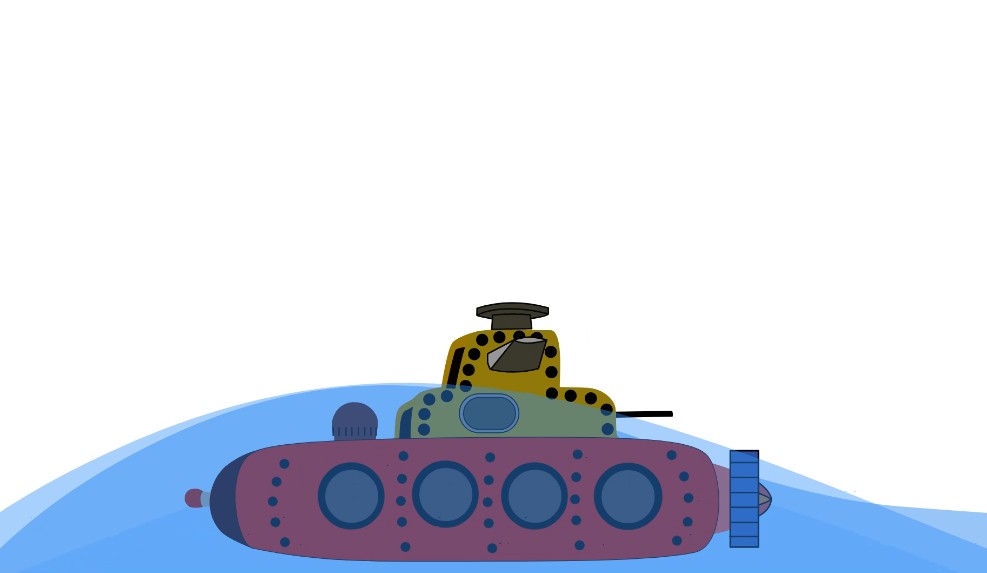
Toon Submarine
Visual Details:
- Subject: A quirky red submarine with a rounded conning tower, a periscope, a small antenna, and a rear propeller.
- Features: The hull features four distinct circular portholes with blue glass. A black depth charge or torpedo is visible on the front deck.
- Animation: The submarine appears to be bobbing gently on the surface of stylized blue waves. The animation likely includes a subtle rocking motion, water displacement, and potentially a rotating propeller or moving periscope.
- Style: “Toon” aesthetic with bold outlines, solid colors, and no complex shading, ensuring fast loading times and crisp rendering on all devices.
Technical Specifications:
- Format: Lottie JSON
- Best for: Web and mobile apps where file size and scalability are critical.
- Benefits: The vector-based JSON file is tiny in size, loads instantly, and can be scaled to any resolution without pixelation. It supports programmatic control (e.g., changing colors via code) and interactivity.
- Use Case: Loading screens, UI feedback icons, or animated background elements.
- Format: MP4
- Best for: Social media, video editing, and platforms that do not support Lottie players.
- Benefits: Universally compatible with all video players and social platforms.
- Use Case: Storytelling, social media posts, or embedding in standard video content.
Lottie JSON is a lightweight, open-source animation format developed by Airbnb. It allows designers to export animations as JSON files that can be rendered natively on iOS, Android, Web, and Windows without needing to re-author them for each platform.
Here are the key aspects:
- Format: It uses JSON (JavaScript Object Notation) to define vector-based animations, shapes, colors, and keyframes.
- Renderer: Instead of playing a video file, a library (like
lottie-webfor the web, or native libraries for mobile) reads the JSON and renders the animation in real-time. - Benefits:
- Scalability: Being vector-based, it looks crisp on any screen resolution.
- Small File Size: JSON files are typically much smaller than equivalent video files (MP4, GIF).
- Interactivity: Because it’s code-based, developers can easily control playback speed, loop settings, or even animate specific parts of the graphic via code.
- Design Workflow: Designers create animations in Adobe After Effects or Figma and export them using the Lottie plugin to a
.jsonfile.
It is widely used for micro-interactions, loading spinners, icons, and complex motion graphics in apps and websites.
Lottie JSON revolutionized web and mobile animation by bridging the gap between design and development. Traditionally, animations required heavy video files or complex custom code, limiting performance and flexibility. With Lottie, designers craft intricate motion graphics in Adobe After Effects using the Bodymovin plugin, exporting them as tiny JSON files. Developers then drop these files into an app using a lightweight renderer, instantly displaying crisp, scalable animations that load in milliseconds.
Because the animation is defined by data rather than pixels, it supports dynamic changes via code. You can alter colors, speeds, or even trigger specific animation segments based on user interaction, all without re-exporting assets. This makes Lottie ideal for onboarding screens, error states, and interactive icons, ensuring a smooth, high-performance experience across all devices while drastically reducing bandwidth usage compared to traditional video formats.




Reviews
There are no reviews yet.